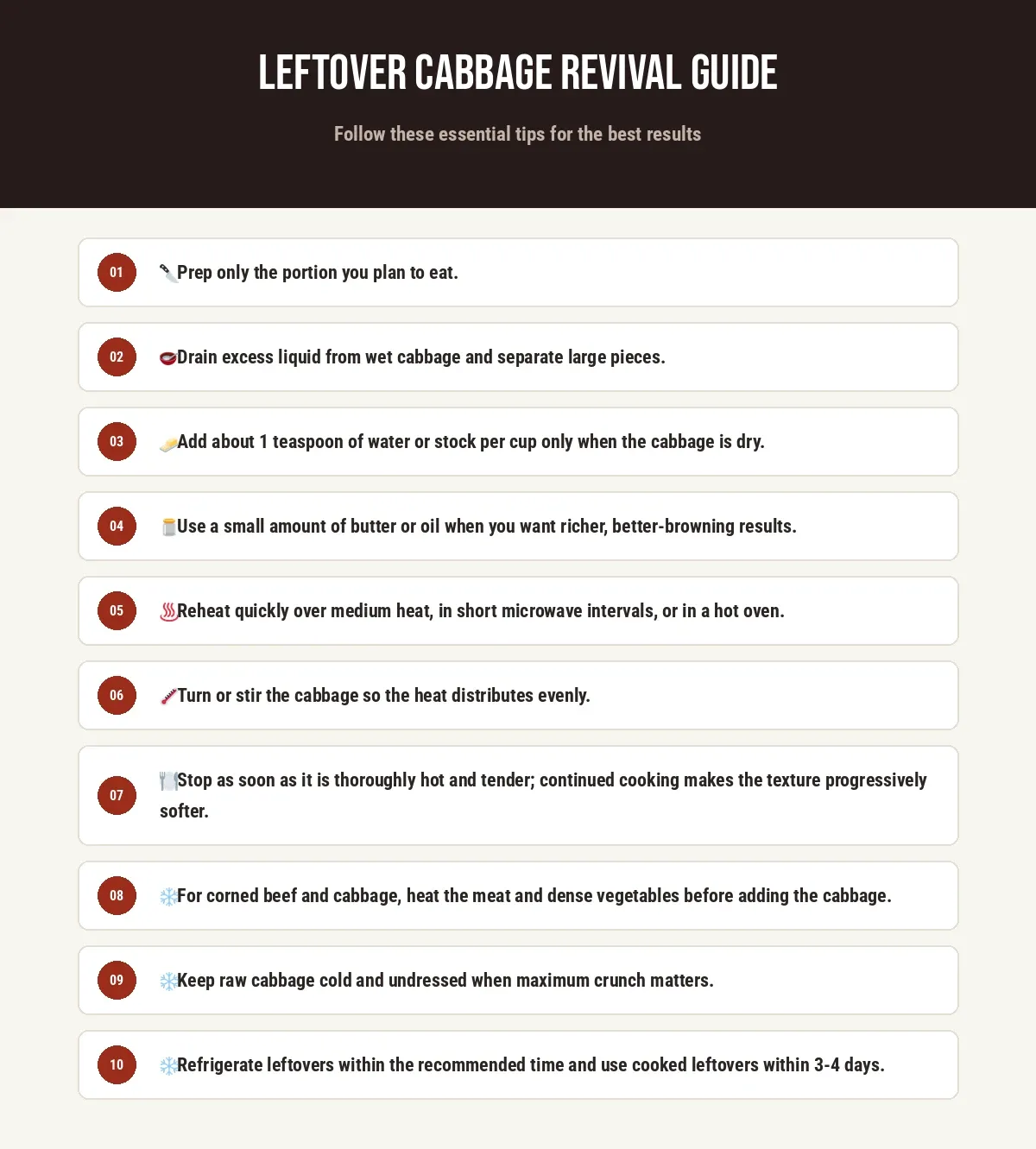
Leftover cabbage is easy to save, but it rarely improves with repeated reheating. The goal is not to cook it again from scratch. The goal is to warm it quickly, control excess moisture, and stop heating as soon as it reaches serving temperature. Boiled cabbage, roasted cabbage, raw slaw, and cabbage cooked with corned beef all behave differently, so use the revival method that matches the original preparation.
For the best result, refrigerate leftovers promptly, keep cooked cabbage in a shallow airtight container, and reheat only the portion you plan to eat. A large cold mass takes longer to heat and spends more time steaming itself, which makes already-soft cabbage even more limp.
Why Leftover Cabbage Loses Its Texture?
Cabbage contains a large amount of water held inside plant cells. Cooking softens the cell walls and weakens the pectin and other structural components that normally keep the leaves crisp. Boiling is especially aggressive because heat and water rapidly soften the tissue while some soluble compounds move into the cooking liquid.
After refrigeration, the cabbage is already structurally tender. Reheating pushes it further: the remaining cell walls lose more strength, water migrates out of the damaged cells, and steam accumulates between the leaves. If the cabbage sits in a pool of liquid, it absorbs moisture while becoming softer rather than regaining its original firmness. Prolonged microwave heating can produce the same effect because the vegetable heats rapidly from its internal water.
The practical rule is simple: leftover cabbage needs brief, high-efficiency reheating rather than prolonged cooking. A dry skillet can drive off surface moisture and lightly brown the edges. A covered pan with a small amount of liquid is better when the cabbage has become dry. Raw cabbage should generally not be "revived" by heating at all; preserve its crunch by keeping it cold and adding it to the finished dish.
Step-by-Step Revival: A 3-step Guide
Step 1: Prep
Remove only the portion you intend to serve. If the cabbage is in large wedges, separate the leaves or cut the pieces into roughly even portions so they heat at the same rate. Drain away accumulated liquid from boiled cabbage and gently blot very wet pieces with a paper towel. Do not squeeze aggressively, because that forces out the remaining moisture that gives cooked cabbage its tender texture.
For cabbage mixed with corned beef, potatoes, carrots, or other vegetables, separate the pieces when practical. Dense meat and potatoes need more heating time than cabbage. Heating everything together usually leaves the cabbage overcooked before the other ingredients are hot.
Step 2: Moisture
For plain boiled or steamed cabbage that feels dry, add about 1 teaspoon of water or unsalted stock per cup of cabbage when reheating in a covered pan or microwave-safe dish. Covering traps the resulting steam and prevents the vegetable from drying further. For a richer preparation, use about 1 teaspoon of butter or olive oil per cup instead; fat coats the surface and improves the perception of tenderness without adding excess water.
If the cabbage is already wet, add nothing. Instead, use an uncovered skillet so excess moisture can evaporate. For cabbage that will be folded into a dish such as fried rice, soup, pasta, or a hash, the other ingredients can supply the necessary moisture and fat.
Step 3: Heat
Use moderate heat and stop as soon as the cabbage is thoroughly hot. In a skillet, heat a small amount of butter or oil over medium heat, add the cabbage in a relatively even layer, and turn it occasionally. The ideal result is hot throughout with visible steam, tender leaves, and lightly browned edges rather than a wet, collapsing mass. In a microwave, cover the cabbage loosely, heat in short intervals, and stir or rearrange between intervals. Avoid repeated long blasts.
| Reheating method | Cooking time | Setting / temperature | Best portion size | Instructions |
|---|---|---|---|---|
| Skillet | 3-6 minutes | Medium heat | 1-2 cups | Add cabbage to a lightly greased skillet. Cook uncovered, turning occasionally. Add 1 tsp water or stock per cup only if dry. |
| Microwave | 1-3 minutes | High, in short intervals | 1-2 cups | Place in a covered microwave-safe dish. Add 1 tsp water per cup if needed. Heat for 30-60 seconds at a time and stir between intervals. |
| Oven | 10-15 minutes | 350°F / 175°C | 2-4 cups | Spread in a shallow baking dish, cover tightly, and add a small splash of water or stock if dry. Uncover for the final few minutes if excess moisture remains. |
| Air fryer | 4-7 minutes | 350°F / 175°C | 1-2 cups | Dry the surface first. Lightly coat with oil and heat in a single layer, shaking or turning once. Best for firmer, browned cabbage. |
| Steaming | 2-4 minutes | Gentle steam | 1-2 cups | Use only when the cabbage is dry. Steam briefly until hot; do not leave it over boiling water once heated. |
3 Simple Culinary Ideas To Repurpose Leftover Cabbage
Cabbage Hash
Chop cooked cabbage into bite-size pieces and combine it with diced cooked potatoes, onions, and leftover corned beef or another cooked protein. Fry the mixture in a lightly oiled skillet over medium-high heat until the bottom develops browned patches. Turn it in sections rather than constantly stirring so it has time to develop color. Finish with black pepper, mustard, or a small splash of vinegar to cut through the richness.
Cabbage Fried Rice
Finely chop leftover cabbage and add it near the end of a fried-rice recipe. Cook the rice and other ingredients first, then stir in the cabbage for the final few minutes. This preserves more of its structure than cooking it from the beginning. A little soy sauce, scrambled egg, scallion, and sesame oil can turn a small amount of leftover cabbage into a complete meal.
Cabbage Soup
Use soft leftover cabbage as a ready-to-cook ingredient in vegetable soup, bean soup, or a broth-based meal. Add it toward the end because it is already cooked. Simmer only until hot, then season with salt, pepper, herbs, vinegar, or a small amount of lemon juice. This is particularly useful for cabbage that has become too soft to serve attractively on its own.
Handling Boiled, Raw, And Corned Beef Cabbage Leftovers
Boiled cabbage benefits most from fast reheating with controlled moisture. Drain it well and use a skillet when it is excessively wet; use a covered pan or microwave when it has dried out.
Raw cabbage should stay raw when you want to preserve its crunch. Keep shredded cabbage cold, dry, and separate from watery dressings until serving. If raw cabbage has already been dressed, its texture will continue declining as salt and acid draw water from the vegetable. Use it promptly rather than trying to restore its original crispness with heat.
Corned beef and cabbage should be treated as a mixed leftover rather than one uniform ingredient. Slice or shred the corned beef, cut dense vegetables into smaller pieces, and reheat the meat and potatoes before adding the cabbage. This prevents the cabbage from spending unnecessary time in the heat. A skillet is particularly effective because it can brown the beef and potatoes while warming the cabbage briefly at the end.
Food Safety
-
Cool promptly: Refrigerate cooked cabbage and corned beef within 2 hours of cooking or serving, or within 1 hour when the surrounding temperature is above 90°F (32°C). Divide large amounts into shallow containers so they cool quickly.
-
Store airtight: Keep leftovers in clean, airtight containers and refrigerate at 40°F (4°C) or below. Minimize repeated opening and closing, and store meat-and-vegetable mixtures in containers small enough to cool efficiently.
-
Use within 3-4 days: Refrigerated cooked cabbage and corned beef should generally be eaten within 3-4 days. Reheat leftovers until they reach 165°F (74°C), particularly when meat is included. If they have been refrigerated longer than the recommended period, discard them rather than relying on smell or appearance.