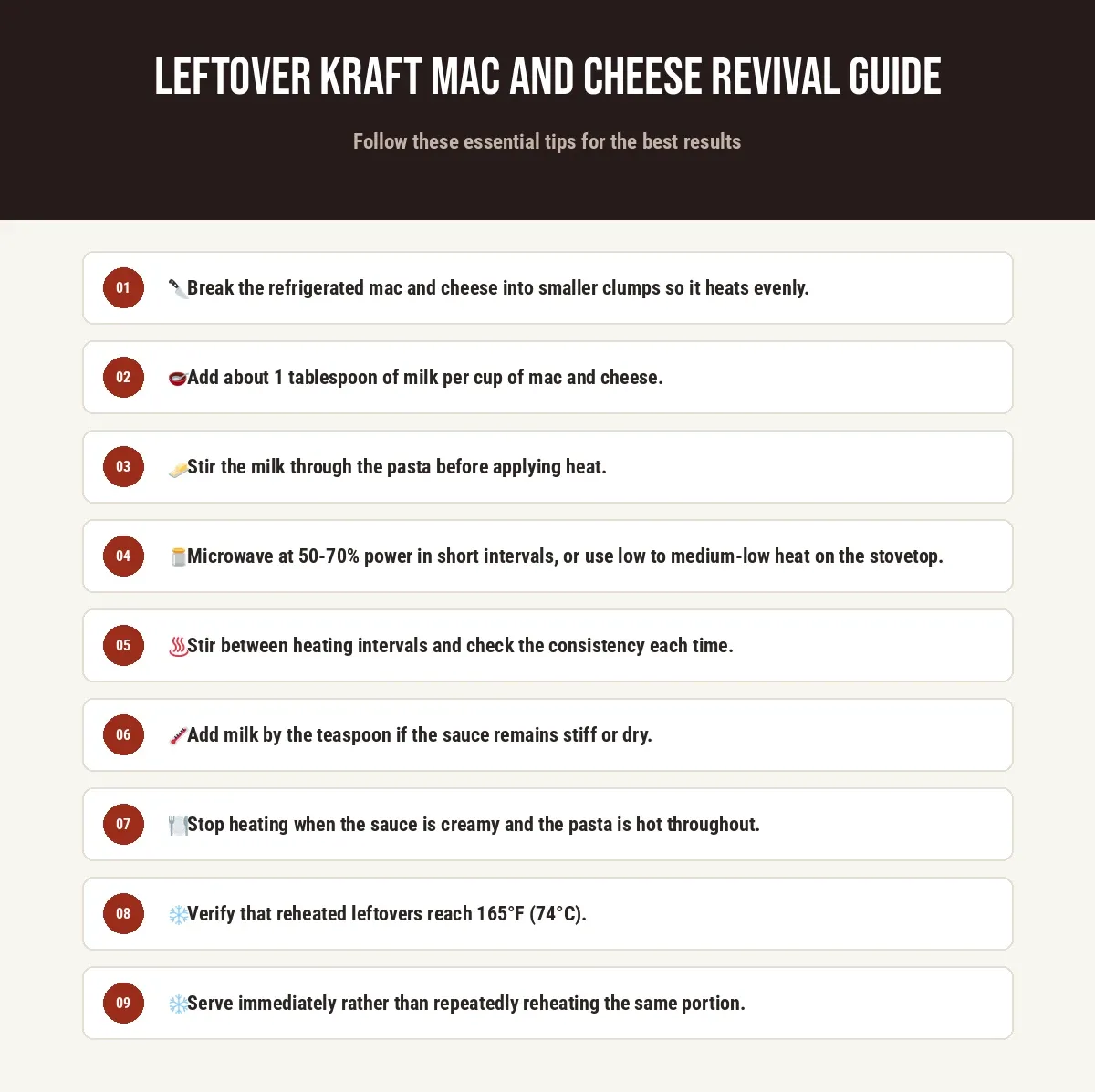
Leftover Kraft Mac & Cheese is easy to save, but it rarely tastes as creamy on day two. The pasta continues absorbing moisture while it sits, and the cheese sauce becomes thicker and less fluid. The good news: you do not need to throw it away or drown it in extra cheese. A small amount of moisture, gentle heat, and constant attention can bring much of the original texture back.
The key is to treat refrigerated mac and cheese as a starch-and-cheese emulsion that needs moisture and controlled reheating. High heat can make the sauce greasy or rubbery, while dry reheating leaves the macaroni tough and the sauce pasty. Revive only the portion you plan to eat so the remaining food stays safely refrigerated.
Why Leftover Kraft Mac And Cheese Loses Its Texture?
The main problem starts with the macaroni. During cooking, the pasta absorbs water and its starch granules swell. Once the mac and cheese is refrigerated, the starch molecules gradually reorganize and tighten in a process called retrogradation. The pasta therefore becomes firmer, while some of the moisture that originally kept the cheese sauce fluid becomes bound within the starch or redistributed throughout the dish.
The cheese sauce also changes as it cools. Kraft’s prepared cheese sauce contains water, dairy ingredients, fats, proteins, and emulsifying ingredients that help keep the mixture smooth. Refrigeration causes the fat and protein structure to firm up. Meanwhile, the pasta continues taking up available moisture. The result is a thicker sauce, drier noodles, and a texture that can become clumpy rather than glossy.
Reheating does not automatically reverse these changes. If you blast the leftovers with high heat, water can evaporate faster than it can redistribute, while the dairy and fat components can separate. That is why a microwave-heated bowl can develop hot, dry edges and a dense center even when the total heating time is short.
The most effective fix is to add back a small amount of moisture before heating and warm the food gradually. You are not trying to cook the macaroni again. You are giving the concentrated sauce enough liquid to loosen and allowing that liquid to spread through the starch as the dish warms.
Step-by-Step Revival: A 3-step Guide
Step 1: Prep
Remove only the serving you intend to eat and put it into a microwave-safe bowl or a small saucepan. Break apart large refrigerated clumps with a fork or spoon, but do not aggressively mash the pasta. Separating the mass increases the exposed surface area and helps the added liquid distribute evenly.
If the mac and cheese has been refrigerated in a large container, do not try to reheat the entire container repeatedly. Portioning it first gives you better control over temperature and texture and avoids repeatedly warming food that you are not going to eat.
Step 2: Moisture
Add milk first. For roughly 1 cup of leftover Kraft Mac & Cheese, start with 1 tablespoon of whole or 2% milk. Add another teaspoon or two only if the mixture remains very thick. The goal is to loosen the sauce, not turn the dish soupy.
For an especially rich result, replace part of the milk with a small amount of half-and-half. A teaspoon of butter can also help restore richness, but it should supplement the milk rather than replace it because butter alone does not provide enough water to rehydrate the starch.
Stir the milk through the cold mac and cheese before heating. This distributes the liquid instead of leaving it sitting on top, where it can heat unevenly or evaporate.
Step 3: Heat
For the microwave, cover the bowl loosely and heat at about 50-70% power in 30-second intervals, stirring thoroughly after each interval. Lower power gives the cold center time to warm while reducing the risk of scorching the edges. Stop as soon as the sauce becomes creamy and the macaroni is heated throughout. If it still looks tight or sticky, stir in another teaspoon of milk rather than simply increasing the heat.
For the stovetop, use a small saucepan over low to medium-low heat. Stir frequently and scrape the bottom so the sauce does not stick. Add another small splash of milk if the mixture becomes thicker as it warms. The ideal finished texture is loose, creamy, and glossy, with the sauce coating the noodles instead of sitting as a stiff paste. For food safety, leftovers should reach 165°F (74°C) when reheated.
| Reheating method | Approx. time | Setting / temperature | Best portion size | Instructions |
|---|---|---|---|---|
| Microwave | 1-2 minutes | 50-70% power | 1 cup | Add 1 tbsp milk, cover loosely, heat in 30-second intervals, and stir after each interval. |
| Microwave | 2-4 minutes | 50-70% power | 2 cups | Add 2 tbsp milk, cover loosely, heat in 30-45-second intervals, and stir thoroughly between intervals. |
| Stovetop | 3-6 minutes | Low to medium-low | 1-2 cups | Add milk, place in a saucepan, stir frequently, and remove from heat as soon as the sauce is smooth and hot. |
| Oven | 15-25 minutes | 325-350°F | 2-4 cups | Transfer to a covered baking dish, stir in milk, cover tightly with foil, and heat until hot throughout. |
| Oven | 20-30 minutes | 325-350°F | 4+ cups | Use a covered casserole dish, add enough milk to loosen the mixture, stir once during heating if practical, and heat to 165°F. |
The microwave is usually the best choice for a single serving because it minimizes additional cooking time and moisture loss. The stovetop gives you the most control because you can continuously adjust the milk and heat. The oven is useful for a larger quantity but requires a covered dish to prevent the surface from drying out.
3 Simple Culinary Ideas To Repurpose Leftover Kraft Mac And Cheese
Turn It Into A Crispy Skillet Mac And Cheese
Cold mac and cheese holds together well enough to become a crisp skillet dish. Add the leftovers to a lightly greased nonstick skillet over medium heat and press them into an even layer. Let the bottom develop a golden crust before turning or stirring. Add cooked vegetables, shredded chicken, peas, or chopped broccoli if you have small amounts of leftovers that need using. The contrast between the crisp exterior and creamy center makes the leftovers feel substantially different from the original meal.
Make A Mac And Cheese Frittata
Mix cold mac and cheese with beaten eggs and any small amounts of cooked vegetables, herbs, or leftover meat that need using. Cook the mixture gently in an oven-safe skillet until the bottom sets, then finish it in the oven until the eggs are fully cooked. Keep the ratio balanced: too much macaroni makes the mixture heavy, while enough egg allows the pieces to bind into slices. This works particularly well when the original mac and cheese has already become too thick to enjoy on its own.
Build A Crispy Mac And Cheese Bake
Spread the leftovers into a small baking dish and loosen them with a little milk. Add whatever suitable leftovers are available, such as cooked vegetables or shredded cooked chicken. Top lightly with breadcrumbs and a small amount of grated cheese if available. Bake until the center is hot and the topping is crisp. This method turns a texture problem into an advantage because the formerly thick sauce provides structure while the breadcrumb topping supplies the missing contrast.
Re-Emulsifying Boxed Macaroni And Homemade Cheese Casseroles
Boxed Kraft Mac & Cheese and homemade cheese casseroles need slightly different treatment because their sauces are built differently. Boxed mac and cheese generally responds well to a modest splash of milk and gentle reheating because its prepared cheese sauce is designed to remain relatively smooth. Homemade casseroles can contain larger amounts of natural cheese, cream, butter, or roux, so separation is more likely if they are overheated.
For either type, re-emulsification means encouraging the water, fat, dairy proteins, and starch to come back together instead of allowing them to separate. Gentle heat is critical. Add liquid before heating, keep the temperature moderate, and stir whenever the structure of the dish allows it. If a homemade casserole looks oily after reheating, adding more heat usually makes the separation worse; a small amount of warm milk stirred in gradually can help bring the sauce back together.
Avoid adding a large quantity of cold liquid all at once. It can make the sauce unevenly diluted and create a watery layer around the pasta. Small additions followed by thorough stirring give you much better control.
Food Safety
-
Cooling time: Refrigerate leftover mac and cheese within 2 hours of cooking or serving, or within 1 hour if the surrounding temperature is above 90°F (32°C). Divide a large quantity into shallow containers so it cools more quickly rather than leaving a deep, hot container on the counter.
-
Airtight storage: Store the leftovers in a clean, airtight container or tightly covered dish. Keep the refrigerator at 40°F (4°C) or below. Good sealing limits moisture loss, which helps both food quality and texture.
-
Safe fridge days: Use refrigerated leftovers within 3-4 days. When reheating, heat the portion to 165°F (74°C). Reheat only what you plan to eat, because repeatedly warming and cooling the same container is unnecessary and makes quality deteriorate faster.