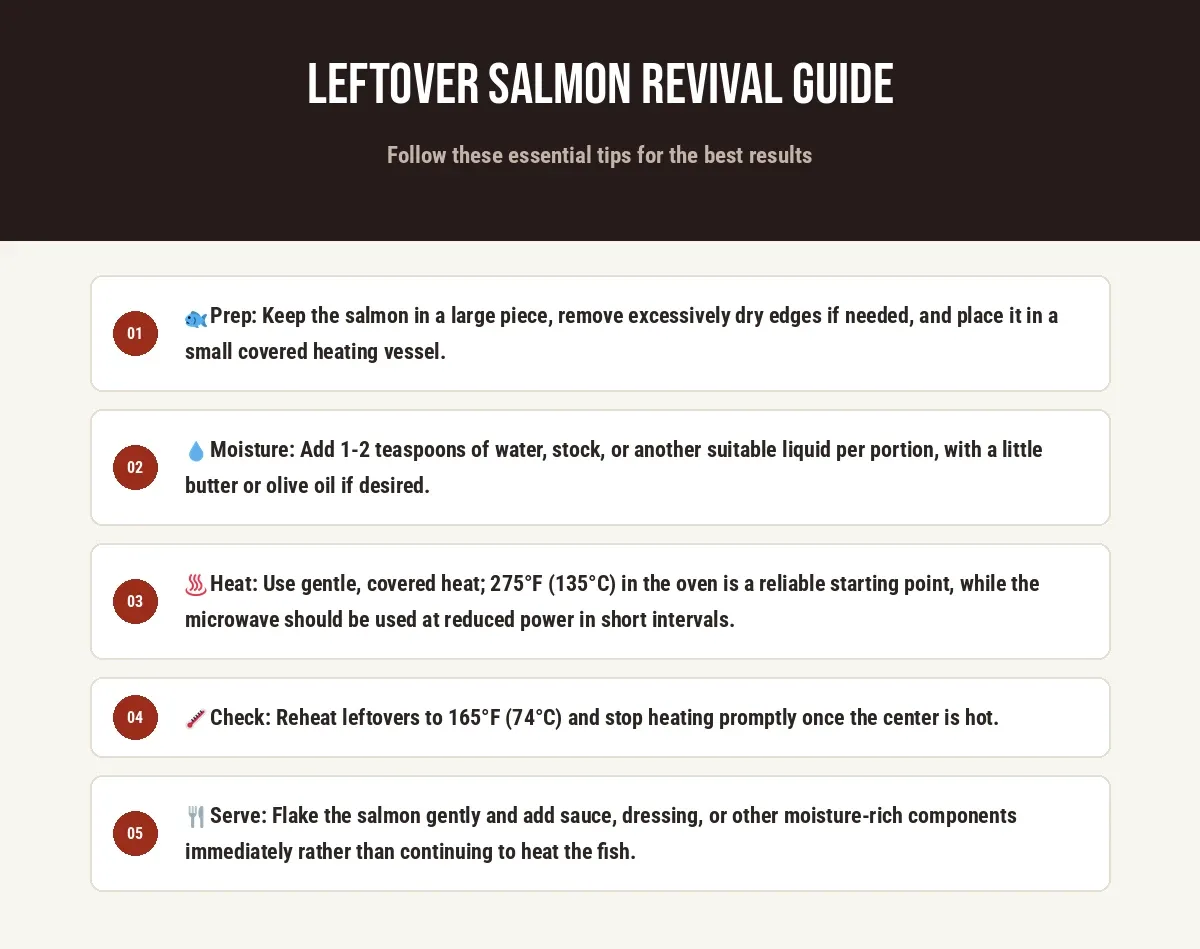
Leftover salmon is worth saving, but reheating it like a fresh fillet is the fastest way to make it dry, firm, and chalky. The goal is not to cook the salmon again. It is to warm it gently while replacing some of the moisture that escaped during its first cooking and subsequent refrigeration.
Use low, controlled heat, add a small amount of moisture, and stop as soon as the salmon is hot enough to serve. If the fish is already cooked, every extra minute of high heat pushes its texture farther from the tender, flaky result you started with.
Why Leftover Salmon Loses Its Texture?
Salmon loses its texture mainly because its muscle proteins tighten during cooking and continue to suffer moisture loss when the cooked fish is reheated. Heat causes proteins such as myosin to denature and contract, squeezing water out of the muscle fibers. Refrigeration then firms the fish further because chilled proteins and fats become less yielding.
A second heating cycle compounds the problem. The hotter and longer the reheating, the more moisture migrates out of the fish. A microwave can create particularly uneven heating: exposed edges may become dry while the center is still cool. A dry skillet has a similar problem because the surface is exposed directly to intense heat.
The fix is gentle, humid heat. A covered oven dish, low-temperature skillet, or carefully controlled microwave can trap steam and reduce evaporation. A spoonful of water, stock, or another suitable liquid creates a humid environment; a small amount of olive oil or butter can also improve the eating quality, although fat does not replace the water that was lost from the fish.
Step-by-Step Revival: A 3-step Guide
Step 1: Prep
Take the salmon from the refrigerator and remove any very dry edges or darkened exposed portions if necessary. Keep the fillet intact rather than breaking it into small pieces; a whole or large portion loses moisture more slowly. If the salmon has sauce, vegetables, or other toppings attached, separate components that need different heating times.
For a thick fillet, let it sit briefly while you prepare the heating vessel, but do not leave cooked salmon at room temperature for an extended period. Place the portion in a small covered baking dish, microwave-safe container, or skillet where it fits relatively snugly. Keeping the fish surrounded by a little moisture is more effective than exposing it to a large dry cooking surface.
Step 2: Moisture
For each salmon portion, add about 1-2 teaspoons of water, fish stock, vegetable stock, or lemon-free white wine to the heating vessel. Water is the simplest choice because it produces steam without adding a competing flavor. Add about 1 teaspoon of olive oil or butter for a richer result if the salmon is particularly lean or dry.
Do not pour liquid directly over the top in large quantities. The objective is to create gentle steam around the fish, not soak it. Cover the dish tightly with an oven-safe lid or foil for oven reheating, or use a vented microwave cover when microwaving. For smoked salmon, skip this step unless you are incorporating it into another cooked dish; delicate smoked salmon is generally better served cold or added after the hot components are finished.
Step 3: Heat
For the most even result, use a covered oven at 275°F (135°C). Heat a refrigerated salmon portion gently until it is hot throughout, checking early because thinner pieces warm quickly. For food-safety purposes, USDA guidance is to reheat leftovers to 165°F (74°C); use an instant-read thermometer in the thickest part when practical. The salmon should feel hot in the center and separate into moist flakes when pressed gently with a fork. Stop heating as soon as it reaches the safe temperature rather than continuing until the surface looks browned or dry.
| Reheating method | Typical setting | Approx. time | Best use | Instructions |
|---|---|---|---|---|
| Covered oven | 275°F / 135°C | 10-20 min | 1-4 fillets | Put salmon in a small covered dish with 1-2 tsp liquid per portion. Heat gently and check the center early. |
| Microwave | 50-70% power | 30-90 sec per portion, in intervals | 1 portion | Add 1-2 tsp water or stock, cover, heat in 20-30 sec bursts, and rotate or reposition between bursts. |
| Covered skillet | Low heat | 5-10 min | 1-2 portions | Add 1-2 tbsp water or stock to the pan, place salmon in it, cover, and warm gently. Avoid vigorous simmering. |
| Steam | Gentle steam | 4-8 min | 1-2 portions | Put salmon on a heatproof plate above simmering water and cover. Check frequently to prevent overcooking. |
| Air fryer | 275-300°F / 135-150°C | 4-8 min | 1-2 portions | Use only for salmon that benefits from a slightly firmer exterior. Add a light coating of oil and check early; uncovered hot air dries fish quickly. |
3 Simple Culinary Ideas To Repurpose Leftover Salmon
Salmon Cakes
Flake cold leftover salmon and mix it with mashed potato, a beaten egg, chopped herbs, and enough breadcrumbs to hold the mixture together. Form small patties and chill them briefly so they stay intact. Pan-cook over medium heat with a thin film of oil until both sides are crisp and the center is hot. This works especially well for salmon that has already become slightly dry because the potato and egg provide a new, cohesive texture.
Salmon Fried Rice
Break the salmon into large flakes rather than tiny crumbs. Stir-fry cold cooked rice with vegetables and your preferred seasonings, then add the salmon near the end so it warms without spending several minutes against the hot pan. A splash of soy sauce, sesame oil, or a little stock can restore moisture. If the salmon is already seasoned, reduce the added salt accordingly.
Salmon Grain Bowl
Use cold or gently warmed salmon over rice, quinoa, couscous, or another cooked grain. Add crunchy vegetables and a moisture-rich dressing such as yogurt-herb sauce, tahini dressing, or a simple olive-oil vinaigrette. This is one of the easiest ways to use a small leftover portion because the dressing compensates for some dryness without requiring another round of cooking.
Reheating Cooked Fillets Vs. Delicate Smoked Salmon
Cooked salmon fillets can be reheated because they have already been fully cooked and can tolerate gentle secondary heating. Their main challenge is moisture loss, so covered, low-temperature heating is the priority. Thick fillets benefit from slower heating; thin pieces need much less time.
Smoked salmon is different. Cold-smoked salmon is delicate, thin, and already ready to eat, so conventional reheating can make it greasy, tough, or overly dry while destroying some of its intended texture. Keep it refrigerated and serve it cold, or add it to a hot dish after the main cooking is finished. If you are making pasta, eggs, potatoes, or a grain bowl, let the residual heat warm the smoked salmon rather than frying it aggressively.
Food Safety
-
Cooling time: Refrigerate cooked salmon within 2 hours of cooking or serving, or within 1 hour when the surrounding temperature is above 90°F (32°C). Divide a large quantity into shallow containers so it cools faster instead of leaving a deep container of hot fish to cool slowly.
-
Airtight storage: Store salmon in a clean, airtight container or wrap it tightly to limit air exposure, odors, and moisture loss. Keep the refrigerator at 40°F (4°C) or below. Store sauces and other components separately when doing so will make reheating more even.
-
Safe fridge days: Use cooked salmon within 3-4 days when continuously refrigerated at 40°F (4°C) or below. If it has been refrigerated longer than that, discard it rather than trying to make it safe through reheating. When reheating a retained portion, bring leftovers to 165°F (74°C).