How to Fix Cold, Dry Leftover Rice in Minutes
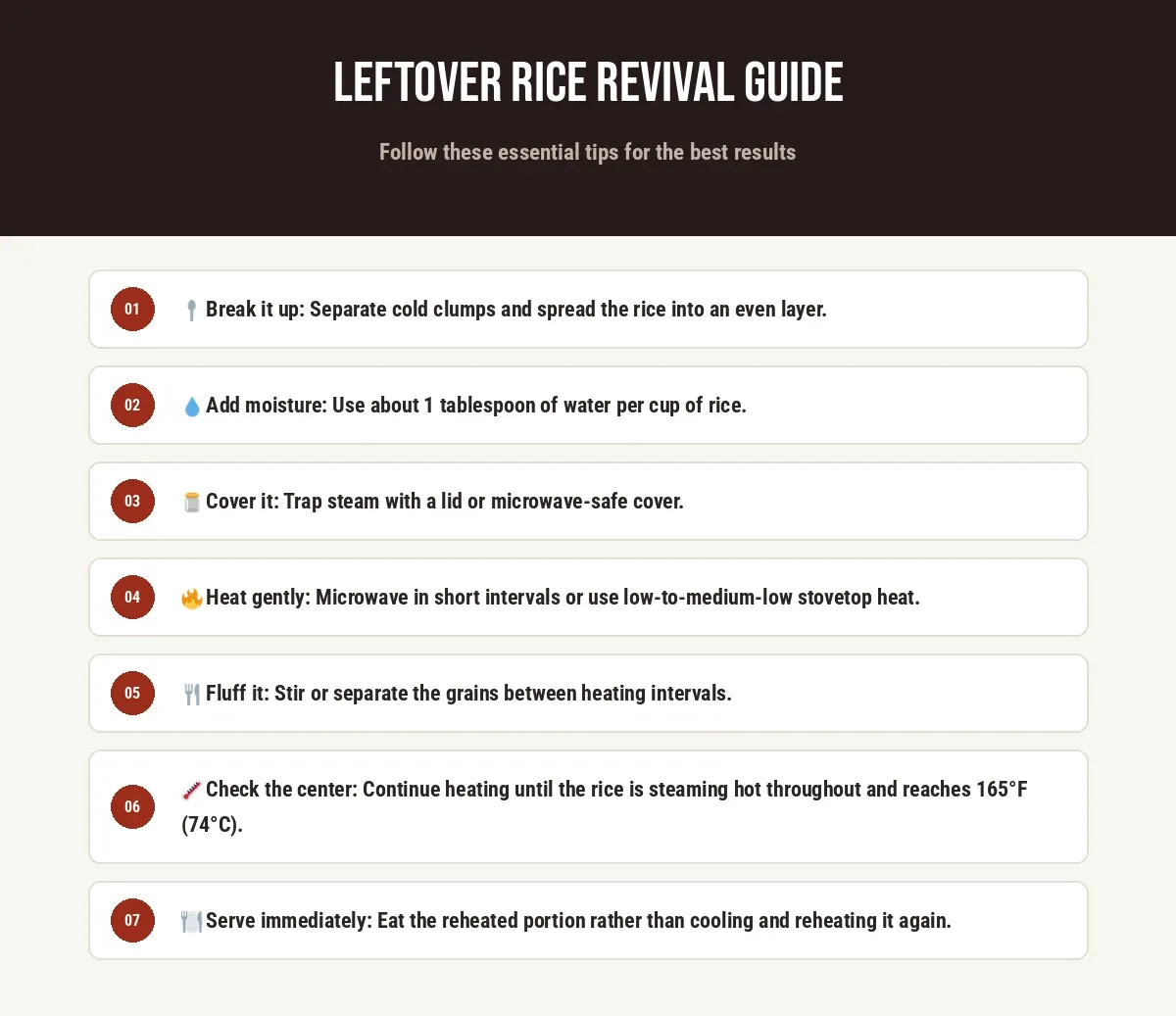
Leftover rice is worth saving, but it needs the right treatment. Refrigeration protects cooked rice from spoilage, yet it also changes its texture: grains become firmer, drier, and more tightly packed. The good news is that properly stored rice can usually be revived in minutes. The key is to restore moisture before the rice overheats, then use a heating method that distributes that moisture evenly.
For the best results, reheat only the amount you plan to eat. A small portion heats faster and more evenly than a large container, reducing the time the rice spends warming through. Add a small amount of water, cover the rice, and heat until it is steaming hot throughout. Once revived, use it immediately rather than repeatedly cooling and reheating the same batch.
Why Leftover Rice Loses Its Texture?
Freshly cooked rice contains starch granules that have absorbed water during cooking. As the rice cools, some of those starch molecules reorganize and form a firmer structure, a process called starch retrogradation. This makes refrigerated rice feel harder, drier, and less tender even though the rice has not necessarily lost all of its moisture.
Refrigeration also makes the texture more noticeable because the rice grains become firmer and clumps stick together. Simply heating cold rice without adding moisture can make the problem worse. Heat drives off remaining surface moisture, leaving the grains dry and chewy rather than soft.
Revival works by adding water back into the rice and trapping steam around the grains. The added moisture penetrates the starch structure as the rice heats, helping soften the grains. Covering the rice is important because it keeps steam from escaping. A little water is usually enough; flooding the rice creates a wet, mushy texture.
Step-by-Step Revival: A 3-step Guide
Step 1: Prep
Transfer the amount of rice you need to a microwave-safe bowl, saucepan, or skillet. Break apart large clumps with a fork or clean, damp fingers so the rice forms a loose, relatively even layer. Remove any unusually dry, hardened pieces if they will not separate easily. If the rice contains mixed ingredients such as vegetables, meat, or sauce, distribute everything evenly so cold spots are minimized.
Do not heat an entire dense block of refrigerated rice. The center can remain cold while the outside becomes excessively hot and dry. For a large quantity, divide the rice into smaller portions before reheating.
Step 2: Moisture
For every 1 cup of cooked rice, sprinkle in about 1 tablespoon of water. Plain water is the best general-purpose choice because it restores steam without substantially changing the flavor. For particularly dry rice, increase the amount slightly, but stop before the grains are visibly sitting in liquid.
Cover the bowl tightly with a microwave-safe lid or plate, leaving the manufacturer’s recommended vent if required. In a saucepan or skillet, add the water around the rice rather than pouring a large amount directly onto the grains, then cover with a lid. The goal is to create steam that surrounds the rice while it heats. A teaspoon of neutral oil or butter can also be added when you want a richer, looser texture, but fat should supplement-not replace-the water needed for rehydration.
Step 3: Heat
Microwave the rice covered on high power in short intervals, stirring or fluffing between intervals so the heat and moisture redistribute. For stovetop reheating, use low to medium-low heat with the pan covered and stir periodically. The rice is ready when it is steaming hot throughout, the grains separate easily with a fork, and the center is no longer cool or hard.
For food safety, reheated leftovers should reach 165°F (74°C). Avoid repeatedly reheating the same batch; portioning before heating gives you better texture and reduces unnecessary temperature changes.
| Reheating method | Approx. time | Setting/temperature | 1 serving | 2-4 servings | Best instructions |
|---|---|---|---|---|---|
| Microwave | 1-2½ minutes | High power | Add about 1 tbsp water per cup; cover and heat in 30-60 second intervals | Use a wide covered dish; heat in 60-90 second intervals, stirring between rounds | Best for speed. Stir midway and check that the center is steaming hot. |
| Stovetop saucepan | 5-8 minutes | Low to medium-low | Add 1 tbsp water per cup, cover, and heat gently | Use a wider pan and add enough water to generate steam without pooling around the rice | Fluff frequently. Lower the heat if the bottom begins to brown before the rice is hot. |
| Covered skillet | 4-7 minutes | Low to medium-low | Add rice, 1 tbsp water per cup, and cover | Spread rice in a thin layer rather than piling it deeply | Useful when you want separate grains. Stir occasionally to prevent sticking. |
| Steamer | 5-10 minutes | Steaming | Spread rice loosely in the steamer basket | Keep the rice in a shallow layer for even steaming | Excellent for restoring softness without directly soaking the grains. |
3 Simple Culinary Ideas To Repurpose Leftover Rice
Turn It Into Fried Rice
Cold rice is particularly useful for fried rice because refrigeration firms the grains and reduces their tendency to collapse when stirred. Break up the rice before cooking, then fry it in a hot skillet with a small amount of oil. Add vegetables, cooked protein, egg, or aromatics according to what needs using up. Keep the pan hot and avoid overcrowding it; excess moisture can steam the rice instead of frying it. Add sauces near the end so the grains remain distinct.
Make Rice Porridge
When the rice is too dry or clumped to revive attractively, turn that weakness into an advantage. Combine it with several times its volume of water or broth and simmer until the grains break down and the mixture becomes creamy. Add shredded vegetables, cooked chicken, tofu, or an egg for a complete meal. This is especially useful for rice that has been refrigerated for several days but remains within the safe storage period.
Stuff Vegetables Or Make Rice Patties
Mix leftover rice with finely chopped cooked vegetables, beans, herbs, or other leftovers and use it as a filling for bell peppers, tomatoes, or zucchini. Alternatively, combine the rice with a binding ingredient such as beaten egg, shape it into compact patties, and pan-cook until crisp outside and hot inside. This approach gives dry or slightly firm rice a second purpose without requiring it to return to its original texture.
Rehydrating Different Grains (Jasmine, Basmati, And Brown Rice)
Jasmine rice generally revives quickly because its grains are relatively tender and aromatic. Use about 1 tablespoon of water per cup of cooked rice, cover tightly, and heat gently. Fluff with a fork once steaming hot. Avoid excessive water because jasmine rice can become soft and sticky quickly.
Basmati rice benefits from gentle steaming. Its long, slender grains are easiest to preserve when you avoid aggressive stirring. Sprinkle the water over the rice, cover, and heat until steaming. Separate the grains with a fork rather than pressing them together with a spoon.
Brown rice has a firmer bran layer and generally needs more time to soften. Start with about 1 to 1½ tablespoons of water per cup, cover well, and heat more gradually. If the grains remain firm after the first heating cycle, add a small additional splash of water and continue heating rather than adding a large quantity all at once.
Food Safety
-
Cool promptly: Refrigerate cooked rice within 2 hours of cooking or serving, or within 1 hour when the surrounding temperature is above 90°F (32°C). Divide large quantities into shallow containers so they cool rapidly rather than remaining warm in the center for an extended period. Cooked rice can support growth of Bacillus cereus if it is left at unsafe temperatures for too long.
-
Store airtight: Use clean, airtight containers and refrigerate at 40°F (4°C) or below. Keep rice separate from raw foods that could contaminate it, and do not leave a large pot of freshly cooked rice sitting on the counter to cool slowly. Labeling the container with the cooking date makes the storage window easier to track.
-
Use within 3-4 days: Refrigerated cooked rice should generally be eaten within 3-4 days. Reheat only the portion you intend to eat and heat it to 165°F (74°C). If rice has been left at room temperature too long, smells or looks abnormal, or you are unsure how it was stored, discard it rather than trying to rescue it through reheating.