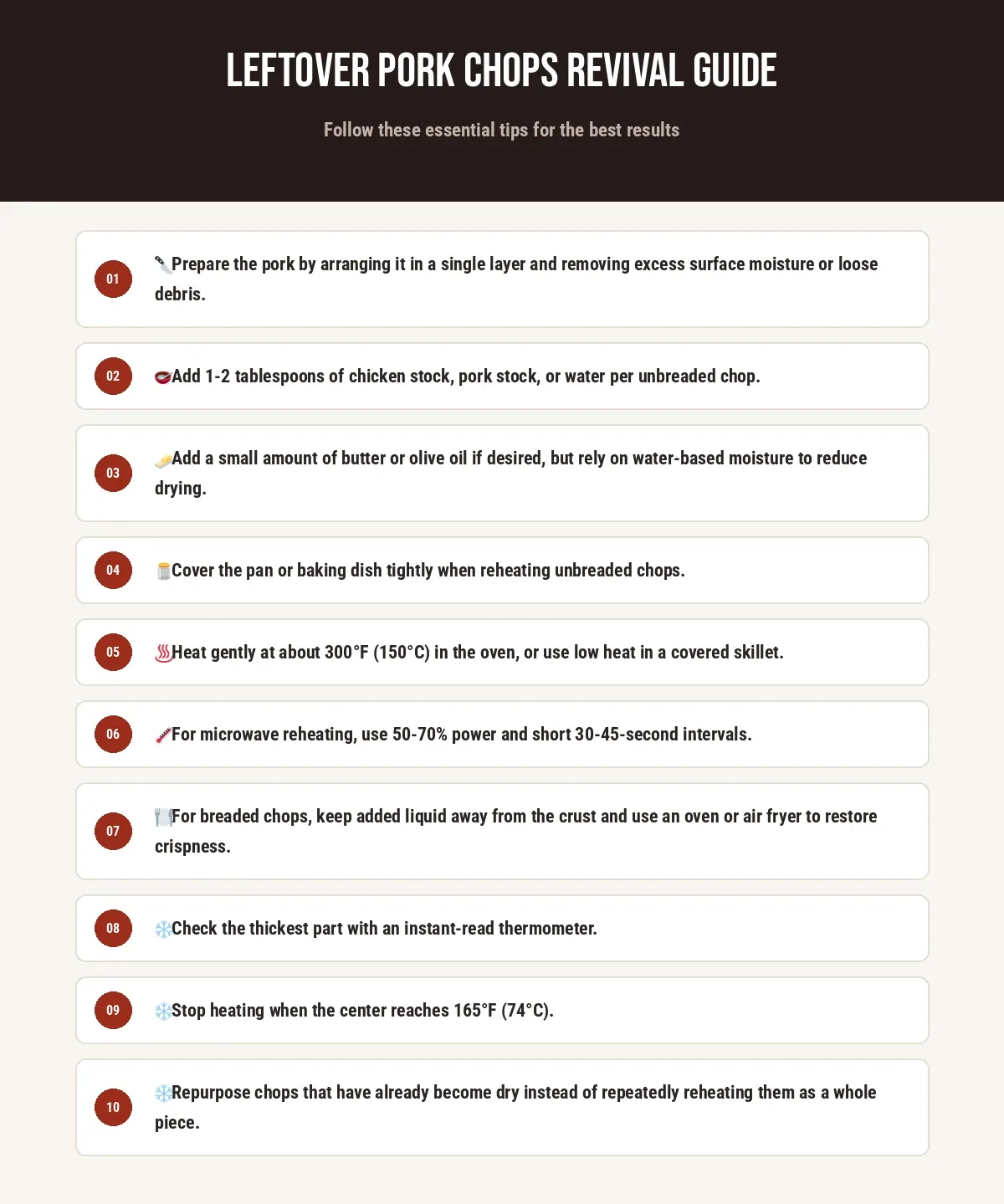
Leftover pork chops can be excellent the next day, but reheating them like a fresh dinner often produces a dry, chewy result. The key is to avoid prolonged high heat. Pork chops are relatively lean, so they have little internal fat or connective tissue to protect them during reheating. Your goal is not to cook them again. It is to warm them through while minimizing additional moisture loss.
The best approach is simple: prepare the chops so they heat evenly, add a small amount of moisture, then use gentle heat. Thick chops tolerate oven or covered-skillet reheating particularly well. Thin chops need even more caution because they heat rapidly and can become overcooked within minutes.
Why Leftover Pork Chops Loses Its Texture?
Cooked pork loses tenderness primarily because heat changes the proteins in its muscle fibers. During the original cooking, proteins such as myosin and actin tighten and squeeze water from the muscle structure. When a cooked chop is reheated, those proteins contract further. The more aggressively and for longer they are heated, the more moisture is pushed out.
Refrigeration adds another problem: once the meat cools, its juices redistribute and some of the fat solidifies. The chop therefore starts its second cooking cycle already less juicy than it was when freshly cooked. Reheating it uncovered in a hot oven, skillet, or air fryer exposes the surface to dry heat while the interior warms, increasing evaporation from the exterior and driving more moisture out of the muscle.
Thin or boneless chops are especially vulnerable because they have a high surface-area-to-volume ratio. They reach serving temperature quickly, leaving very little margin between "warm" and "overheated." Breaded chops have a separate texture problem: moisture migrating from the meat can soften the coating, while aggressive dry heat can make the breading hard before the center is properly warmed.
The practical rule is to use moderate heat, add controlled moisture, cover when appropriate, and stop heating as soon as the chop is hot throughout.
Step-by-Step Revival: A 3-step Guide
Step 1: Prep
Take the pork chops from the refrigerator and remove excess sauce, loose crumbs, or condensation from the surface. If the chops are very thick, cut them into smaller portions only if you plan to use them in another dish; keeping an intact chop generally helps it retain more moisture.
For sauced or unbreaded chops, place them in a single layer so the heat reaches them evenly. If the meat has a particularly dry surface, lightly brush it with the cooking juices left in the storage container. Do not soak it. Excess liquid can make the exterior wet without meaningfully restoring moisture inside the meat.
For breaded chops, do not rinse or heavily coat the crust. Instead, preserve the dry exterior and use a heating method that allows the coating to crisp again.
Step 2: Moisture
For unbreaded pork chops, add about 1 to 2 tablespoons of low-sodium chicken stock, pork stock, or water per chop. Chicken stock is particularly useful because it adds moisture without overwhelming the existing seasoning. A teaspoon of butter or olive oil can also be added to the surface for extra richness, but fat alone does not replace the water lost during cooking.
Place the liquid around the chop rather than pouring it directly over a crisp surface. Cover the pan or baking dish tightly. The trapped steam raises humidity around the meat and reduces evaporation while the chop warms.
For breaded pork chops, skip the added liquid on the crust. If they seem dry, place a very small amount of water or stock underneath the rack or on the bottom of the pan, keeping the breading above the liquid. This creates gentle humidity without turning the coating soggy.
Step 3: Heat
For most leftover pork chops, a covered oven at about 300°F (150°C) is the most forgiving method. Heat until the center reaches 165°F (74°C), measured with an instant-read thermometer, because USDA guidance recommends reheating leftovers to 165°F. Once that temperature is reached, remove the chops immediately rather than continuing to cook them.
A properly reheated chop should feel hot in the center without becoming noticeably firmer as it sits. The meat should remain moist when sliced, and any added stock should be hot rather than merely lukewarm. For breaded chops, the coating should feel crisp or firm rather than wet and limp.
| Reheating method | Setting | Approx. time | 1 chop | 2-4 chops | Best use |
|---|---|---|---|---|---|
| Covered oven | 300°F / 150°C | 15-25 min | Check around 12-15 min | Check around 18-25 min | Thick, boneless or bone-in chops |
| Covered skillet | Low heat | 6-12 min | 3-5 min per side, with 1-2 tbsp stock | Work in a single layer; add a little more stock | Fast reheating of unbreaded chops |
| Microwave | 50-70% power | 2-4 min | Heat in 30-45 sec intervals | Arrange in one layer; rotate between intervals | Small portions when speed matters |
| Air fryer | 300-325°F / 150-165°C | 5-10 min | Check early | Avoid crowding the basket | Breaded chops needing crispness |
Microwave reheating requires the most care. Cover the chop loosely with a microwave-safe cover, use reduced power, and heat in short intervals. Let it rest for about 30 seconds between intervals so residual heat can spread through the meat. High power for several uninterrupted minutes is one of the easiest ways to turn a leftover pork chop tough.
For breaded chops, the air fryer or a moderately hot oven generally gives a better crust than the microwave. Avoid very high temperatures: they can brown or harden the coating before the center warms.
3 Simple Culinary Ideas To Repurpose Leftover Pork Chops
Pork Chop Fried Rice
Cut the pork into small cubes and add it near the end of a fried-rice recipe rather than frying it from the beginning. Cook the rice, vegetables, and egg first, then fold in the pork with soy sauce or another sauce during the final minute or two. The pork only needs to warm through, which limits additional moisture loss. This works particularly well with chops that are slightly dry because the sauce and rice provide additional moisture.
Pork And Apple Skillet
Slice the pork thinly and warm it gently with sautéed apples, onions, and a small splash of chicken stock. Add mustard or a little apple cider vinegar for acidity. Keep the pork out of the pan until the apples and onions are nearly finished, then add the slices just long enough to heat them. The sweet, acidic sauce gives dry leftover meat more perceived juiciness without requiring you to overcook it.
Crispy Pork Chop Sandwiches
Slice or chop the pork and combine it with a flavorful sauce such as barbecue sauce, mustard-based sauce, or a lightly spiced yogurt sauce. If the chop is breaded, re-crisp it first in an oven or air fryer, then assemble the sandwich immediately. Add crunchy lettuce, cabbage, pickles, or sliced vegetables for contrast. This turns a chop that is no longer ideal as a stand-alone entrée into a filling where sauce and fresh ingredients compensate for some loss of juiciness.
Keeping Breaded and Boneless Pork Chops Tender
Breaded chops should be reheated differently from thick bone-in chops. Their crust needs dry heat, while their meat needs gentle heat. A moderate oven or air fryer is therefore preferable to adding liquid directly to the breading. Heat the chop until the center reaches 165°F, then stop immediately.
Boneless chops require particular attention because they can overheat quickly. Keep them covered when using an oven or skillet, use low-to-moderate heat, and check the temperature early. If a boneless chop is already noticeably dry, repurposing it with a sauce, grain, sandwich, or stew-like preparation is often more successful than repeatedly reheating it as a plain chop.
Food Safety
-
Cooling time: Refrigerate cooked pork within 2 hours of cooking or serving; if the surrounding temperature is above 90°F (32°C), refrigerate it within 1 hour. Divide a large quantity into shallow containers so it cools more quickly rather than leaving a deep container of hot meat to cool slowly.
-
Airtight storage: Store chops in airtight containers or tightly wrapped packaging to limit air exposure, surface drying, and odor transfer. Keep the refrigerator at 40°F (4°C) or below, and store the meat promptly rather than waiting for it to cool completely on the counter.
-
Safe fridge days: Use refrigerated cooked pork within 3-4 days. Reheat leftovers to 165°F (74°C). If you will not eat the pork within that window, freeze it promptly rather than extending its refrigerator life.