Leftover pork shoulder is one of the easiest meats to save and one of the easiest to ruin on the second day. The first cook breaks down tough connective tissue and renders fat slowly, leaving the meat tender and juicy. Reheating can undo some of that work if you expose the already-cooked pork to too much direct heat or leave it uncovered.
The goal is not to cook leftover pork shoulder again. The goal is to bring it back to serving temperature while minimizing additional moisture loss. Keep the pork in larger pieces when possible, add a small amount of moisture, cover it during gentle heating, and uncover it only when you want to restore a browned or crisp surface. Boston butt and pork belly need slightly different treatment because their fat and connective-tissue content behave differently during reheating.
Why Leftover Pork Shoulder Loses Its Texture?
Pork shoulder, including Boston butt, contains substantial amounts of muscle fibers, connective tissue, and rendered fat. During the original low-and-slow cook, collagen converts into gelatin, which gives the meat its characteristic tenderness. Once the pork has been cooked and chilled, however, the muscle fibers are already fully cooked. Reheating them too aggressively causes them to contract further and squeeze out water.
The main problem is therefore moisture loss from the muscle fibers, not simply the meat becoming "cold and dry." Chilled pork also contains gelatin and rendered fat that have firmed up in the refrigerator. Gentle reheating melts those components again. High heat, especially uncovered dry heat, evaporates surface moisture faster than the interior can replace it.
Shredded pork is particularly vulnerable because its increased surface area exposes more meat directly to hot air. Thin strands can dry out quickly even while the center of the portion is still warming. Larger chunks retain moisture better because less surface area is exposed.
The fix is straightforward: limit direct heat, introduce a controlled amount of liquid or fat, and trap steam with a lid, foil, or covered baking dish. For pork that was originally crisped, such as pork belly, reverse the process after warming: heat gently first, then use brief high heat to restore the exterior.
Step-by-Step Revival: A 3-step Guide
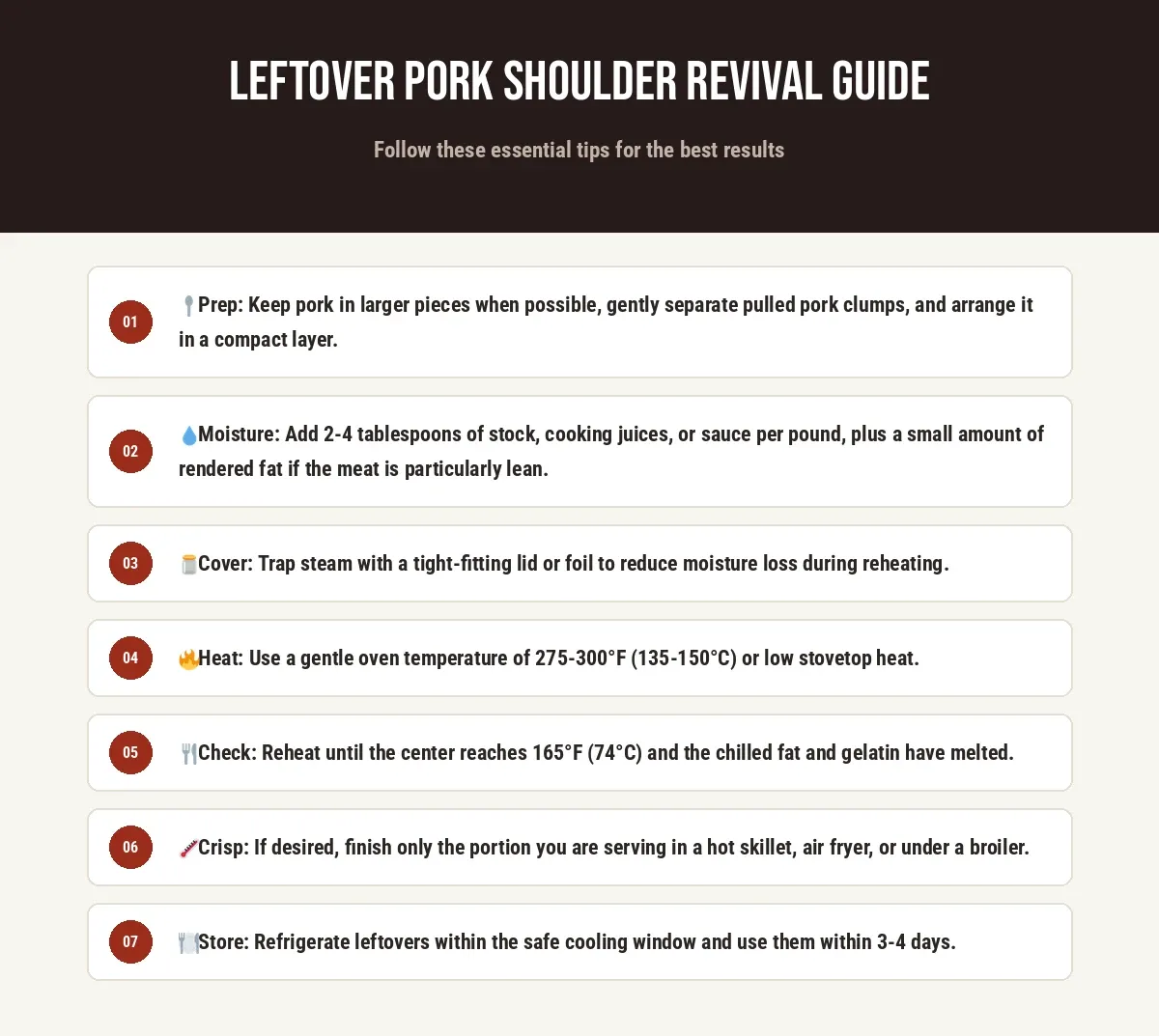
Step 1: Prep
Take the pork from the refrigerator and remove any large pieces of excess fat, cartilage, or bone. Keep substantial pieces intact rather than shredding everything immediately. If the pork is already pulled, gently separate compacted clumps with your fingers or two forks so the heat can reach the meat evenly.
For sauced pork, reserve some of the original cooking juices or sauce. For unsauced pork, arrange the pieces in a single relatively compact layer rather than spreading small pieces widely across a large pan. This reduces exposed surface area and helps prevent the meat from drying.
If you want crisp edges, do not crisp the entire batch during the initial reheating. Warm the pork first, then transfer only the portion you plan to eat immediately to a hot pan, skillet, or broiler-safe tray for finishing.
Step 2: Moisture
Use unsalted chicken stock, pork stock, reserved cooking juices, or a small amount of water mixed with the pork’s original sauce. For about 1 pound of leftover pork, start with 2 to 4 tablespoons of liquid. The liquid should moisten the pork and create steam, not submerge it.
For particularly lean or dry leftovers, add 1 to 2 teaspoons of rendered pork fat, butter, or neutral oil per pound. Rendered pork fat is especially useful because it reinforces the meat’s original richness without adding much water.
Cover the container tightly with a lid or foil. During reheating, the liquid becomes steam while the covering traps that moisture around the meat. If the pork looks dry halfway through heating, add another tablespoon or two of stock rather than simply increasing the temperature.
Step 3: Heat
For the most even result, reheat pork shoulder covered at about 275-300°F (135-150°C) in an oven. Heat until the center reaches 165°F (74°C), which is the recommended reheating temperature for leftovers. The pork should feel hot and tender when pressed with a fork, and any chilled fat or gelatin should have melted back into the meat.
Avoid using a very hot oven to save a few minutes. The outside will dry before the center warms. If you want crisp edges, uncover the pork after it is hot and give it a short blast in a hot skillet or under a broiler, watching closely so the meat browns rather than dries.
| Reheating method | Approx. time | Temperature / setting | Portion and instructions |
|---|---|---|---|
| Covered oven | 20-30 min for 1 lb; 30-45 min for 2-3 lb | 275-300°F / 135-150°C | Put pork in a covered baking dish with 2-4 tbsp stock or cooking juices per pound. Heat until the center reaches 165°F. |
| Covered skillet | 8-15 min for 1-2 cups; 15-20 min for 3-4 cups | Low to medium-low | Add pork and a splash of stock, cover, and stir or turn occasionally. Add liquid if the pan becomes dry. |
| Microwave | 2-4 min for 1 serving; 4-7 min for 2-3 servings | 50-70% power | Add a spoonful of stock or sauce, cover loosely with a microwave-safe lid, heat in 30-60 second intervals, and stir or turn between intervals. |
| Air fryer, after moist reheating | 3-6 min for 1-2 servings | 375-400°F / 190-205°C | Use only after the pork is already hot and moist. Spread in a single layer and cook briefly to crisp the edges. |
| Broiler, finishing only | 1-3 min | High broiler | Place already-hot pork close to the broiler and watch continuously. Best for crisping edges, not for reheating a cold batch from scratch. |
3 Simple Culinary Ideas To Repurpose Leftover Pork Shoulder
Tacos And Quesadillas
Turn reheated pork into a fast taco filling by crisping a small portion in a skillet after warming it with a splash of stock. Add the pork to tortillas with cabbage or another crunchy vegetable, salsa, avocado, or a squeeze of lime. For quesadillas, use the pork sparingly with cheese so the tortilla can brown before the filling becomes dry.
Rice Bowls
Build a rice bowl around the pork instead of treating the meat as the entire meal. Reheat the pork with a little stock or its original sauce, then serve it over freshly cooked rice with beans, corn, greens, pickled vegetables, or a simple fresh salsa. The rice and vegetables add moisture and texture without requiring more meat.
Loaded Baked Potatoes
Warm the pork gently with a little barbecue sauce or cooking liquid and spoon it over a baked potato. Add beans, steamed broccoli, corn, or another vegetable and finish with a modest amount of cheese or plain yogurt. This works especially well for small amounts of leftover pork because the potato turns a few ounces of meat into a complete meal.
Handling Boston Butt And Crispy Pork Belly Leftovers
Boston butt is generally forgiving because it contains substantial connective tissue and fat. Keep larger chunks intact during storage and reheating whenever possible. For pulled pork, add stock or reserved juices and reheat covered. If the pork was originally smoked or barbecued, add a little of its original sauce after warming rather than drowning it before reheating.
Crispy pork belly requires a different approach. Its appeal comes from the contrast between tender meat, rendered fat, and a crisp exterior. Moisture is helpful for warming the meat but harmful to the crisp skin or browned surface. Reheat pork belly gently with the skin or crisp side protected from excess liquid, then finish it uncovered with a skillet, oven, or air fryer to restore crispness. Do not expect a refrigerated crispy surface to remain crisp if it is reheated entirely under steam.
For either cut, separate the amount you plan to eat from the amount you are storing. Repeatedly heating and cooling the entire container increases both quality loss and food-safety risk.
Food Safety
-
Cooling time: Refrigerate cooked pork within 2 hours of cooking or serving; if the surrounding temperature is above 90°F (32°C), refrigerate it within 1 hour. Divide a large quantity into shallow containers so it cools more quickly.
-
Airtight storage: Store pork in clean, airtight containers or tightly wrapped packaging. Minimize excess air and keep the refrigerator at 40°F (4°C) or below. Label containers with the storage date.
-
Safe fridge days: Use refrigerated cooked pork within 3-4 days. Reheat only the portion you intend to eat, and bring leftovers to 165°F (74°C) before serving. Freeze portions that will not be used within that window.