How to Reheat Cooked Fish So the Coating Stays Crisp
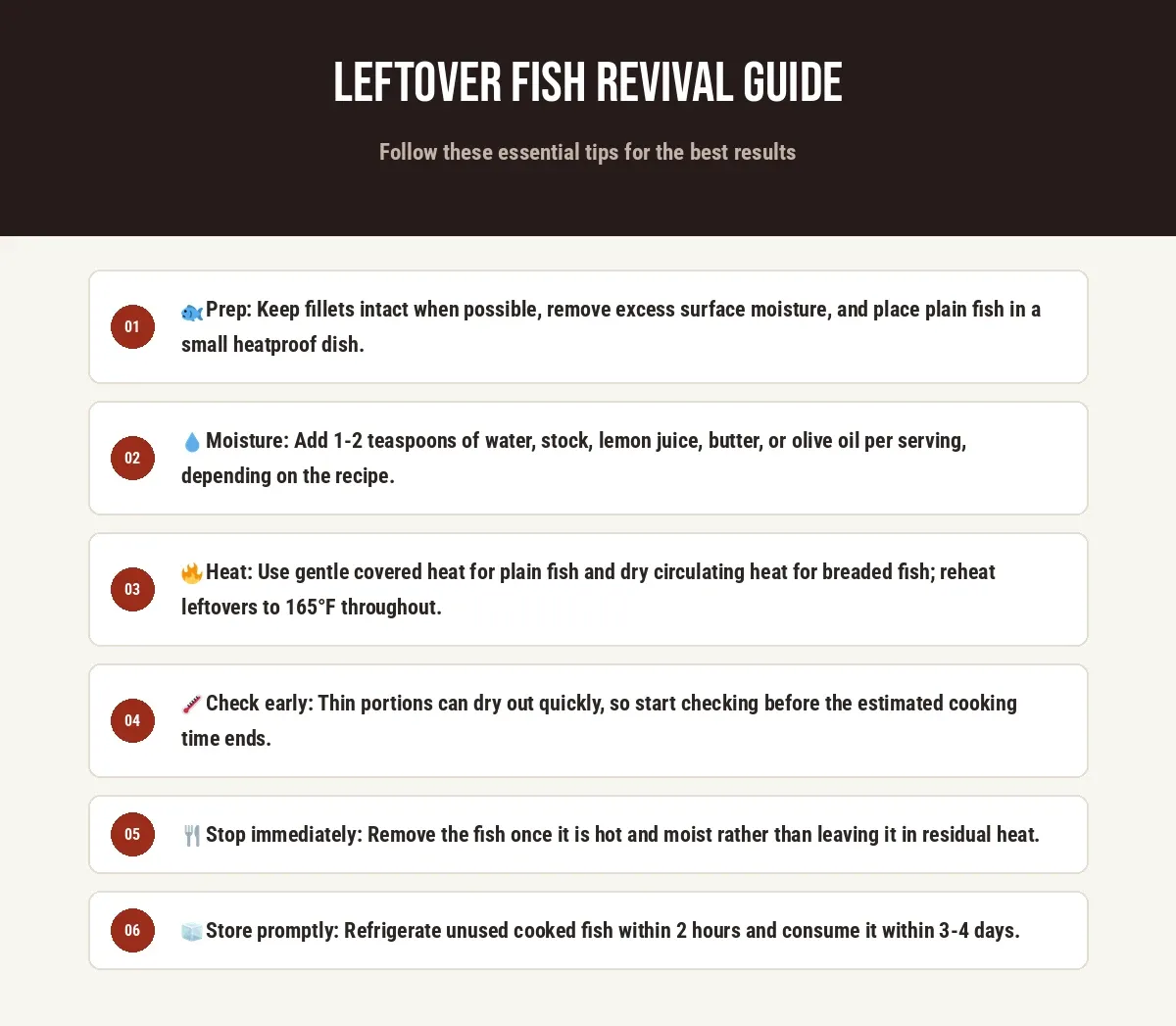
Leftover fish can go from tender to dry, flaky, and tough after one careless reheating. The fix is simple: use gentle heat, add back a small amount of moisture, and stop heating as soon as the fish is safely hot. You do not need to drown it in sauce or cook it for a second time.
The best approach depends on how the fish was originally prepared. A baked fillet benefits from covered, moist reheating, while fried fish needs dry heat to protect its crust. Fish that has already been broken into pieces can be revived particularly well in tacos, rice bowls, pasta, soups, and fish cakes, where added moisture becomes part of the dish rather than something you have to fight.
Why Leftover Fish Loses Its Texture?
Fish has a relatively delicate protein structure and contains far less connective tissue than tougher meats. During the first cooking, heat causes its muscle proteins to contract and release some of their water. Once cooked fish is refrigerated, its flesh becomes firmer as the proteins set and the remaining moisture redistributes.
Reheating creates the bigger problem. High or prolonged heat makes the fish proteins contract further, squeezing out more water. Because fish muscle is made of short, delicate flakes, that lost moisture is immediately noticeable: instead of yielding easily, the flesh becomes dry, firm, and crumbly.
Surface area also matters. A thin fillet reheats much faster than a thick one, so its edges can become overcooked before the center is warm. An uncovered oven or microwave can make this worse by allowing moisture to escape as steam. Fried fish has an additional problem: trapped steam softens the crust if it is reheated in a covered or enclosed environment.
The goal is therefore not to "cook the fish again." It is to bring the leftovers back to serving temperature with the least additional protein contraction possible.
Step-by-Step Revival: A 3-step Guide
Step 1: Prep
Take the fish from the refrigerator and remove any excess sauce, breading, or loose crumbs that could burn during reheating. If it is a thick fillet, leave it intact rather than cutting it into small pieces; a larger piece has less exposed surface area and loses moisture more slowly. For very thick portions, divide them into two even pieces only if necessary to make heating more uniform.
For sauced or baked fish, place the portion in a small heatproof dish so the juices remain around it. If the fish has dried slightly on the surface, brush it lightly with its existing sauce or a thin coating of olive oil. For breaded fish, keep the crust exposed and do not wrap it tightly.
Step 2: Moisture
For plain baked, poached, or grilled fish, add about 1-2 teaspoons of water, fish stock, vegetable stock, lemon juice, or melted butter per individual fillet. Stock or water supplies steam; butter or olive oil adds fat that helps the surface feel moist. Use only a small amount because excess liquid can make the fish soggy.
For fish already sitting in sauce, add no extra liquid unless the sauce has become noticeably thick. Loosen it with a teaspoon or two of water, milk, cream, or stock, depending on the recipe. Covering the dish loosely with foil traps enough steam to protect the flesh without submerging it.
Do not add water to breaded fish. Moisture is useful for the interior but damaging to a crisp coating. Instead, rely on dry circulating heat.
Step 3: Heat
For most leftover fish, use a low oven or covered stovetop method rather than aggressive heat. For a plain fillet, place it in a covered baking dish and heat at about 275°F-300°F until the thickest part reaches 165°F, the USDA-recommended temperature for reheated leftovers. The fish should be hot throughout and separate into moist flakes when pressed gently with a fork; it should not look chalky or release a large pool of liquid.
For breaded fish, use an oven or air fryer so hot air can restore some crispness. Avoid covering it. A microwave is the fastest option, but use short intervals at reduced power and check between intervals because microwave energy can create hot spots and rapidly dry thin edges.
| Reheating method | Typical time | Setting | Best for | Portion guidance |
|---|---|---|---|---|
| Covered oven | 10-20 minutes | 275-300°F | Plain baked, poached, or sauced fish | 1 fillet: begin checking at 10 minutes; 2-4 portions: allow additional time and arrange in a single layer |
| Air fryer | 3-7 minutes | 325-350°F | Breaded or fried fish | 1 portion: begin checking at 3 minutes; multiple pieces need space around them |
| Stovetop | 4-8 minutes | Low heat | Sauced or moist fish | 1-2 portions: use a covered skillet with a splash of stock or water |
| Microwave | 30-90 seconds, plus additional short intervals | 50-70% power | Small portions and sauced fish | Heat one portion at a time when possible; turn or reposition halfway through |
| Steam | 3-8 minutes | Gentle steam | Plain delicate fillets | Use a steamer basket and check frequently so the fish does not become waterlogged |
3 Simple Culinary Ideas To Repurpose Leftover Fish
Fish Tacos
Break the fish into large flakes and warm it gently with a spoonful of salsa, tomato sauce, or stock. Tuck it into warm tortillas with cabbage or lettuce, avocado, corn, and a squeeze of lime. This works especially well for fish that is slightly dry because the toppings and sauce supply moisture without requiring you to overheat the fish.
Fish Rice Bowls
Flake leftover fish over hot rice and add a small amount of soy sauce, sesame oil, or a mild dressing. Add vegetables, herbs, pickles, or a fried egg. For very dry fish, fold it into the rice with a tablespoon of broth or sauce so the rice distributes moisture evenly.
Fish Cakes
Use flaked cooked fish with mashed potato, an egg, herbs, and enough breadcrumbs to form patties. Shape the mixture, chill it briefly if it feels soft, then pan-cook until the exterior is browned and the center is hot. This is particularly useful for small scraps that are awkward to reheat as whole fillets.
Reheating White Fish Varieties (Cod, Tilapia, And Halibut)
Cod has large, delicate flakes and relatively lean flesh, so it benefits from covered reheating with a small amount of stock, water, or butter. Keep the oven temperature moderate and check early; thin cod portions can dry out quickly.
Tilapia is usually thinner than halibut and therefore heats rapidly. Microwave reheating should be done at reduced power in short intervals, while oven reheating works best when the fillet is covered. A thin layer of salsa, tomato sauce, or broth can protect the flesh particularly well.
Halibut has a thicker, meatier texture but is still prone to drying because of its lean flesh. A covered oven dish with a little butter or olive oil and a splash of stock works well. Give thick portions enough time to warm through, but use a thermometer rather than relying on a long fixed cooking time.
For all three varieties, the safest endpoint for reheated leftovers is 165°F in the thickest portion. Once that temperature is reached, remove the fish immediately rather than leaving it in the heat to "cook a little longer."
Food Safety
-
Cooling time: Refrigerate cooked fish within 2 hours of cooking or serving; reduce that limit to 1 hour when the surrounding temperature is above 90°F. Divide a large quantity into shallow containers so it cools more quickly rather than leaving it in a deep, hot container.
-
Airtight storage: Store fish in a clean airtight container or tightly sealed wrapping. Keep the refrigerator at 40°F or below, and position the container where it will stay consistently cold rather than in the refrigerator door.
-
Safe fridge days: Use refrigerated cooked fish within 3-4 days. If you will not eat it within that window, freeze it promptly rather than repeatedly reheating and refrigerating the same portion.