Leftover fried chicken is worth saving. The key is to stop treating it like fresh chicken and reheat it according to what changed during refrigeration. Cold storage firms the coating, redistributes moisture, and leaves the meat more vulnerable to drying during a second heating cycle.
For the closest result to freshly fried chicken, use an oven or air fryer rather than a microwave. The goal is simple: heat the center thoroughly while driving enough surface moisture away to restore crispness without overcooking the meat. A small amount of controlled moisture can help protect the meat, but moisture must stay away from the crust if you want it crisp.
Why Leftover Fried Chicken Loses Its Texture?
Freshly fried chicken has a carefully balanced structure: a moist interior surrounded by a dry, crisp coating. Refrigeration disrupts that balance.
The meat gradually loses some of its free moisture as it cools and sits. The coating also absorbs moisture migrating outward from the chicken. What was once a dry, brittle crust becomes softer and less crisp. At the same time, the chicken’s proteins become firmer as the meat cools, so aggressive reheating can make the interior noticeably tougher.
The crust has another problem: trapped water. A crisp fried coating depends on relatively low surface moisture. When moisture from the meat migrates into the breading, the coating loses its crunch. Reheating in a microwave makes this worse because microwave energy heats water efficiently, creating steam throughout the food. The result is hot chicken with a soft or rubbery coating.
Successful reheating therefore requires two different jobs. The interior needs gentle, even heating so it does not dry out, while the exterior needs dry heat so its surface moisture can evaporate. That is why circulating hot air from an oven or air fryer works better than simply blasting the chicken with high heat.
Step-by-Step Revival: A 3-step Guide
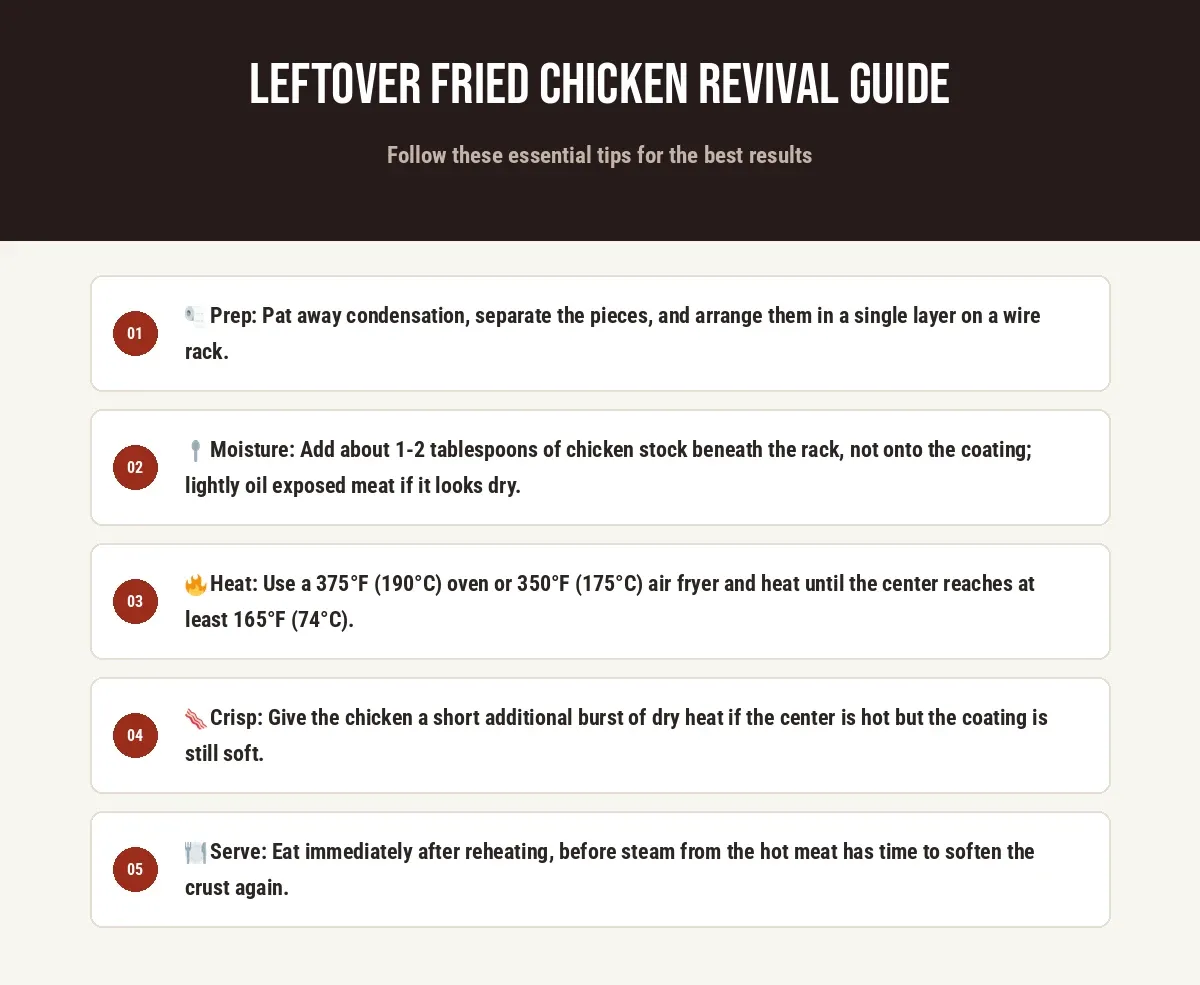
Step 1: Prep
Take the chicken from the refrigerator and remove excess condensation with a paper towel. Do not rinse it. Rinsing adds surface water and makes the coating harder to crisp.
Separate pieces so hot air can circulate around every side. If several pieces are stuck together, gently pull them apart rather than tearing the coating. Arrange them in a single layer, preferably on a wire rack set over a baking sheet. A rack prevents the bottom crust from sitting against a hot, moisture-trapping surface.
For especially thick pieces such as drumsticks, leave the skin and coating intact. Do not cut them open before reheating; doing so allows more moisture to escape and makes the meat dry faster.
Step 2: Moisture
Use a small amount of chicken stock as controlled steam rather than pouring liquid directly onto the chicken. Add about 1 tablespoon of chicken stock to the baking sheet beneath the rack for a small batch, increasing to roughly 2 tablespoons for a larger batch. Keep the liquid below the chicken so it cannot soak the coating.
If the chicken is particularly lean or the exposed meat looks dry, lightly brush the meat-side surfaces with a very small amount of neutral cooking oil, about 1/2 teaspoon per piece. Avoid oiling the breaded exterior heavily; excess oil can make the coating greasy instead of crisp.
The stock provides limited humidity around the meat while the rack keeps the crust above the liquid. The oil helps reduce additional moisture loss from exposed meat during reheating. Neither technique can fully replace moisture that has already been lost, so the most important control is still moderate heat.
Step 3: Heat
Heat the chicken in a preheated oven at 375°F (190°C), or use an air fryer at about 350°F (175°C). Place the pieces in a single layer with space between them. Heat until the thickest part reaches at least 165°F (74°C) on an instant-read thermometer, checking without touching the bone.
For most pieces, the coating should feel firm and crisp when tapped lightly, while the meat should feel hot and supple rather than hard. If the center has reached 165°F but the crust is still soft, give it another short burst of dry heat rather than raising the temperature dramatically. If the exterior is browning too quickly while the center remains cold, lower the heat and continue gradually.
| Reheating method | Typical setting | Approx. time | 1-2 pieces | 3-6 pieces | Best use |
|---|---|---|---|---|---|
| Oven | 375°F / 190°C | 15-25 min | Check around 15 min | Check around 20 min | Best balance of crisp crust and juicy meat |
| Air fryer | 350°F / 175°C | 8-15 min | Check around 8 min | Check around 10-12 min | Fastest route to a crisp coating |
| Toaster oven | 375°F / 190°C | 15-25 min | Check around 15 min | Check around 20 min | Good for small portions |
| Skillet with lid | Medium-low, then medium | 10-18 min | 1-2 pieces | Work in batches | Useful without an oven; crisp uncovered at the end |
| Microwave | High | 1-3 min | Heat in short intervals | Heat in short intervals | Fastest, but produces the softest coating |
Microwave timing varies substantially with wattage and piece size, so use short intervals and check the center frequently. For the crispest result, microwave only to warm the interior and then transfer the chicken to a dry skillet, toaster oven, oven, or air fryer to firm the coating.
3 Simple Culinary Ideas To Repurpose Leftover Fried Chicken
Turn It Into A Hot Chicken Sandwich
Remove the meat from the bones and cut it into bite-size pieces or thick slices. Reheat the chicken separately so the coating stays crisp, then pile it onto toasted bread with shredded lettuce, sliced pickles, and a simple sauce. A little acidity from pickles or a vinegar-based slaw cuts through the fried coating and makes the leftovers taste less like reheated food.
For an especially efficient meal, use leftover dinner rolls or hamburger buns. Toast them in the same oven during the final few minutes of reheating the chicken.
Make Crispy Chicken Tacos
Pull the chicken from the bones and keep the crisp coating in irregular pieces rather than chopping everything finely. Reheat the pieces in an air fryer or skillet, then tuck them into warm tortillas with cabbage, corn, beans, salsa, or a squeeze of lime.
Add cold toppings only after reheating. The contrast between hot, crisp chicken and fresh toppings makes the leftovers feel substantially different without requiring another complicated cooking process.
Build A Fried-chicken Rice Bowl
Remove the meat from the bones and combine it with cooked rice, leftover vegetables, and a strongly flavored sauce. Reheat the chicken separately so it retains some crispness, then add it to the bowl at the end.
This is particularly useful for small amounts of leftover chicken. A single tender or drumstick may not be enough for another standalone meal, but chopped meat can stretch across a bowl with rice, beans, vegetables, or an egg. Keep the chicken separate from wet ingredients until serving to prevent the coating from becoming soggy.
Reheating Specific Cuts (Wings, Drumsticks, And Tenders)
Wings reheat quickly because their smaller size gives heat easy access to the center. Use an air fryer at 350°F (175°C) for roughly 8-10 minutes, turning once if necessary. They are ready when the coating is crisp and the center reaches 165°F (74°C). Avoid prolonged high heat because the relatively small amount of meat can dry out quickly.
Drumsticks contain more meat around a bone, so they need more time than wings. Use a 375°F (190°C) oven for roughly 18-25 minutes, depending on size. Place them on a rack rather than directly on a sheet pan. Check the thickest portion near, but not touching, the bone. The center should reach at least 165°F (74°C), and the exterior should be browned and firm.
Tenders are the easiest to overcook because they are relatively thin and lean. Reheat them at 350-375°F (175-190°C) for approximately 8-15 minutes, checking early. If they are already quite dry, use the lower end of the temperature range and remove them as soon as they reach 165°F (74°C). Their coating can crisp quickly, so do not leave them in the oven simply because the timer has not finished.
Food Safety
-
Cool promptly: Refrigerate leftover fried chicken within 2 hours of cooking or serving, or within 1 hour when the surrounding temperature is above 90°F (32°C). Divide a large quantity into shallow containers so it cools more quickly instead of leaving a deep, hot container to cool slowly.
-
Store airtight: Put the chicken into clean, airtight containers or tightly sealed food-storage bags. Keep the refrigerator at 40°F (4°C) or below. Separating pieces with parchment can prevent the coating from sticking together, but do not sacrifice an airtight seal just to preserve the crust.
-
Use within 3-4 days: Properly refrigerated cooked chicken should be eaten within 3-4 days. Reheat only the portion you plan to eat. Heat leftovers to an internal temperature of 165°F (74°C), measured in the thickest part of the meat.